
Resources · Hands and play
When can my child use scissors?

Scissors look simple until you think about what a child has to do. They need to sit steadily, keep their arm still, open and close their fingers, and use two hands for two different jobs, all while watching a line. No wonder it takes a while.
What about age?
I’d love to give you an age for each step, but the research isn’t there yet. A 2012 paper on scissor skills noted that only two studies of how children’s grip and cutting develop had been published, the earlier one in 1934 [1]. So I’d rather look at what your child can do now and what they enjoy.
Hand games to try
You don’t need scissors to use the hands in a similar way. These games use similar movements and can be fun to do together. They are ideas to try, not a tested program.
- Squeeze, roll and pinch playdough, or snip it, as it’s easier than paper
- Pick up pompoms with tongs
- Water the garden with a spray bottle
- Tear paper into strips for a collage
- Draw on a blackboard, or stick stickers on paper taped to a wall
Holding scissors
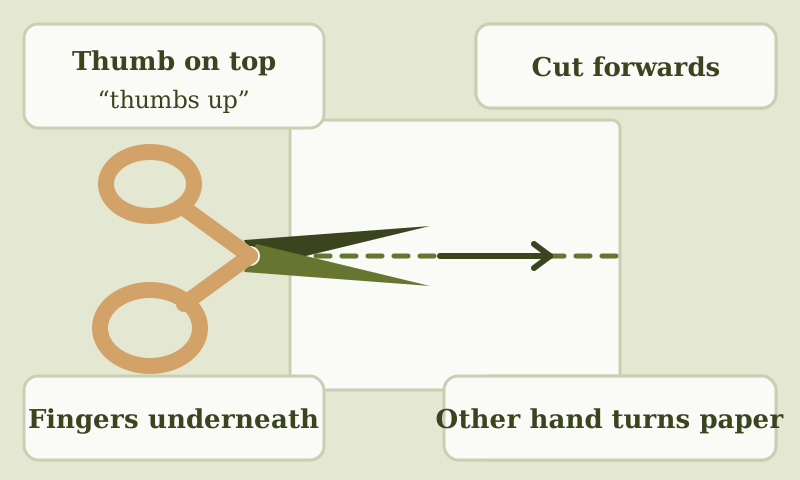
The thumb goes in one loop, with the first and middle fingers in the other. It helps to talk about a “doing hand” and a “helping hand”. Have your child sit with their feet flat and forearms supported on the table. Choose child-sized scissors, and stay close while they’re cutting.
If cutting is tricky
Small changes to the task can make a big difference.
| If you notice | You could try |
|---|---|
| The paper flops around | Thin card in place of paper |
| Your child tires before the end | Quarter sheets, or short strips to snip |
| It’s hard to stay on the line | A thicker line, and make it thinner over time |
| Corners are hard | A sticker or dot showing where to turn |
| Scissors are hard to open and close | Shorter blades, or spring-loaded scissors |
| Your child uses their left hand | Left-handed scissors |
Which hand?
Young children often use either hand. In a review of the research, differences in skill between the two hands were larger in younger children and became more consistent with age, and researchers have not agreed on exactly when hand preference is fully settled [2]. Try not to choose a hand for your child. Put the scissors or pencil in front of them, in the middle, and see which hand they reach for.
If you’re wondering about your child’s hand skills, I’m happy to talk it through. You don’t need a diagnosis or a referral.
References
- Mitchell AW, Hampton C, Hanks M, Miller C, Ray N (2012). Influence of task and tool characteristics on scissor skills in typical adults. American Journal of Occupational Therapy, 66(6), e89–e97
- Scharoun SM, Bryden PJ (2014). Hand preference, performance abilities, and hand selection in children. Frontiers in Psychology, 5, 82
This article is general information. It is not advice about your own child. Talk to your GP or another health professional about any health concern.